Administration & Storage
Administration Overview1
Important Administration Instructions
REZENOPY™ nasal spray is for intranasal use only.
All approved naloxone hydrochloride products achieve plasma concentrations that have been shown to be efficacious in reversing the effects of opioid overdose. Comparing different products on a nominal mg-for-mg basis may be misleading.
Key Administration Points:
- Seek emergency medical care immediately after use. Since the duration of action of most opioids exceeds that of naloxone hydrochloride and the suspected opioid overdose may occur outside of supervised medical settings, seek immediate emergency medical assistance, keep the patient under continued surveillance until emergency personnel arrive, and administer additional doses of REZENOPY nasal spray, as necessary.
- Always seek emergency medical assistance in the event of a suspected, potentially life-threatening opioid emergency after administration of the first dose of REZENOPY nasal spray.
- Additional doses may be required before emergency medical assistance becomes available.
- Do not attempt to reuse REZENOPY nasal spray. Each REZENOPY nasal spray contains a single dose of naloxone.
- Re-administer if needed: Using a new nasal spray, if the patient does not respond within 2 to 3 minutes or responds and then relapses into respiratory depression.
Dosing in Adult and Pediatric Patients1
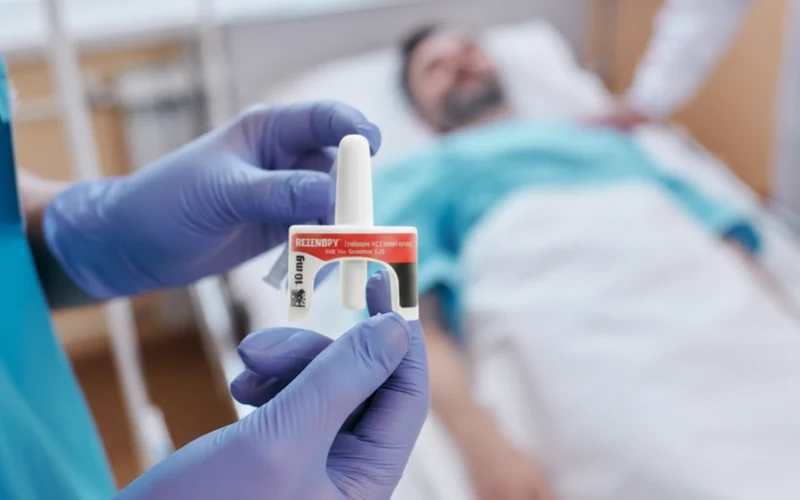
Actor portrayal, not actual patient
Initial Dosing
- The recommended initial dose of REZENOPY nasal spray in adults and pediatric patients is one spray delivered by intranasal administration.
- Administer REZENOPY nasal spray as quickly as possible because prolonged respiratory depression may result in damage to the central nervous system or death.
Repeat Dosing
- Seek emergency medical assistance as soon as possible after administering the first dose of REZENOPY nasal spray.
- The requirement for repeat doses of REZENOPY nasal spray depends upon the amount, type, and route of administration of the opioid being antagonized.
Administer REZENOPY nasal spray in alternate nostrils with each dose.
- If the desired response is not obtained after 2 to 3 minutes, administer a second dose of REZENOPY nasal spray using a new REZENOPY nasal spray device. If there is still no response and additional doses are available, administer additional doses of REZENOPY every 2 to 3 minutes, alternating nostrils and using a new REZENOPY, until emergency medical assistance arrives.
- If the patient responds to REZENOPY nasal spray and relapses back into respiratory depression before emergency assistance arrives, administer an additional dose of REZENOPY nasal spray using a new REZENOPY nasal spray device and continue surveillance of the patient.
- Additional supportive and/or resuscitative measures may be helpful while awaiting emergency medical assistance.
Dosing Modifications
- Partial Agonists or Mixed Agonist/Antagonists: Reversal of respiratory depression by partial agonists or mixed agonist/antagonists, such as buprenorphine and pentazocine, may be incomplete and require higher doses of naloxone hydrochloride or repeat administration of REZENOPY nasal spray using a new nasal spray device.
Instructions1
Step-by-Step Administration
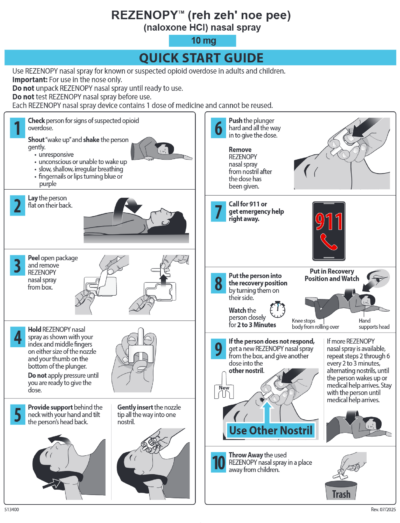
- Positioning: Place the patient in the supine position on their back. Prior to administration, support the back of the neck and tilt the patient’s head back.
- Do NOT prime or test the device prior to administration.
- Insert nozzle: Ensure the device nozzle is inserted in either nostril of the patient.
- Administer: Firmly press the bottom of the device plunger.
- Remove device: Remove the device nozzle from the nostril after use.
- Turn patient: Turn patient on their side and call for emergency medical assistance immediately after administration of the first dose of REZENOPY nasal spray.
- Alternate nostrils: Administer REZENOPY nasal spray in alternate nostrils with each dose.
Product Specifications1
Dosage Form and Strength
- Nasal Spray: 10 mg of naloxone hydrochloride in 0.11 mL in a single dose nasal spray.
How Supplied
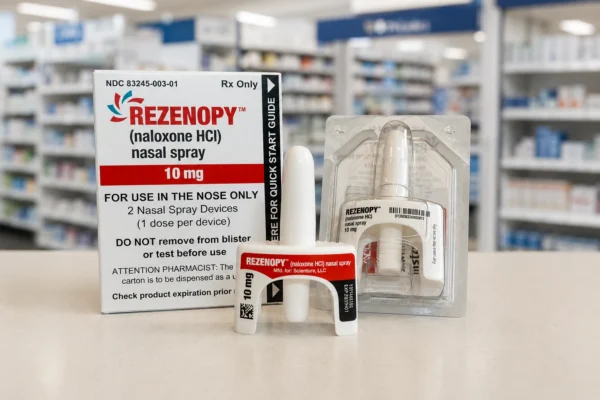
- REZENOPY nasal spray 10 mg is supplied as a carton containing two (2) blister packages (NDC 83245-003-01) each with a single spray device.
- REZENOPY nasal spray is not made with natural rubber latex.
Clinical Pharmacology Highlights1
Pharmacokinetics
- Tmax (median): 0.75 hours (range: 0.25, 1.03 hours)
- Cmax: 9.11 ng/mL (CV 35.45%)
- Half-life: 1.33 hours (CV 16.09%)
- Dose normalized absolute bioavailability vs. IV: 34% (CV 30.53%)
Onset of Action
Rezenopy (a 10 mg naloxone nasal spray) begins working rapidly, with an onset of action typically apparent within 2 to 3 minutes after administration. Because many opioids have a longer duration of action, emergency medical help must be called immediately after giving the first dose.
Special Populations & Contraindications1
Pediatric Use
The safety and effectiveness of REZENOPY for known or suspected opioid overdose as manifested by respiratory and/or central nervous system depression have been established in pediatric patients. Use of naloxone hydrochloride in pediatric patients is supported by adult bioequivalence studies coupled with evidence from the safe and effective use of other naloxone hydrochloride drug products. No pediatric studies were conducted for REZENOPY nasal spray.
Important considerations for pediatric patients:
- Absorption of naloxone hydrochloride following intranasal administration in pediatric patients may be erratic or delayed
- Even when the opiate-intoxicated pediatric patient responds appropriately to naloxone hydrochloride, he/she must be carefully monitored for at least 24 hours, as a relapse may occur as naloxone hydrochloride is metabolized
- In opioid-dependent pediatric patients (including neonates), administration of naloxone hydrochloride may result in an abrupt and complete reversal of opioid effects, precipitating an acute opioid withdrawal syndrome
- Neonatal opioid withdrawal syndrome, unlike opioid withdrawal syndrome in adults, may be life-threatening if not recognized
For neonates: In settings such as in neonates with known or suspected exposure to maternal opioid use, where it may be preferable to avoid the abrupt precipitation of opioid withdrawal symptoms, consider use of an alternate naloxone-containing product that can be dosed according to weight and titrated to effect.
Geriatric Use
Geriatric patients have a greater frequency of decreased hepatic, renal, or cardiac function and of concomitant disease or other drug therapy. Therefore, the systemic exposure of naloxone hydrochloride can be higher in these patients.
Contraindications
REZENOPY nasal spray is contraindicated in patients known to be hypersensitive to naloxone hydrochloride or to any of the other ingredients.
For complete prescribing information, including full safety information, please see the Full Prescribing Information.
Storage & Handling1
Storage Conditions
- Temperature: Store between 2°C to 25°C (36°F to 77°F)
- Excursions permitted: Up to 40°C (104°F)
- Do NOT freeze or expose to excessive heat above 40°C (104°F)
- Light protection: Protect from light
- Packaging: Store REZENOPY nasal spray in the blister and cartons provided
Frozen Product
- REZENOPY nasal spray may freeze at cold temperatures. If this happens, the device will not spray.
- If REZENOPY nasal spray is frozen and is needed in an emergency, do NOT wait for REZENOPY nasal spray to thaw. Get emergency medical help right away.
Expiration
- Replace REZENOPY nasal spray before its expiration date.
References
- REZENOPY™ (naloxone HCl) nasal spray 10 mg [prescribing information]. Commack, NY; Scienture, LLC 2025.
